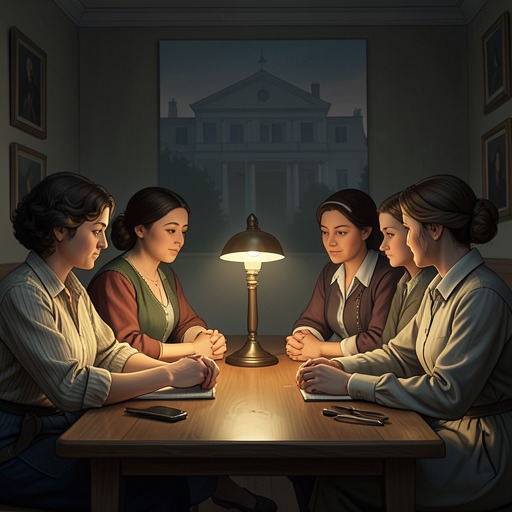
Tate Justice
Bound by DarknessTate Justice is Hunter Fitzsimon’s fiancée and a member of the intimate network surrounding the Paladins’ work along the Barrier. Although the available evidence presents her mainly through Larem q’Jones’s encounters with Hunter and through Sasha Willis’s observations, Tate emerges as more than a companion at the edge of the action: she is a prospective author, a participant in the group’s domestic life, and a stabilizing presence within a story shaped by danger, divided loyalties, and contested belonging.
Identity and Background
Tate is identified as Hunter Fitzsimon’s fiancée. Hunter lives roughly seventy miles north of Seattle, where he watches another stretch of the Barrier, so Tate’s relationship with him connects her to the practical and geographical realities of Paladin service without reducing her to an institutional role. When Sasha Willis sees the couple together, Hunter appears relaxed in Larem’s company, and Tate is introduced as the woman living within that northern orbit rather than as a Paladin operative whose individual history is explained in detail.
Tate’s most distinctive personal pursuit is writing. She tells Larem that her book is almost finished and that she is completing a final polish before querying agents for representation. The ambition is concrete and professional: she is not merely imagining herself as a writer but preparing to submit the manuscript to the publishing world. Hunter’s teasing discussion of the story’s lawman and gunslinger also shows that he has read or heard enough of the book to participate in its imaginative life, making her writing part of their shared relationship.
Connections to the Paladin Community
Tate belongs to the circle that offers Larem practical protection when the Board of Regents’ new policy threatens the Kalith presence among the Paladins. Hunter tells Larem to pack his things and move into the apartment over the garage that he shares with Tate, offering the space for as long as necessary. The offer is later reinforced by Devlin Bane, who admits that moving north with Hunter would be reasonable until the political situation becomes clearer. Tate is therefore associated with a home that can function as refuge, not simply with Hunter’s public duties.
Her connection to Larem is also mediated through Hunter. During an excursion on Puget Sound, Larem spends the day whale watching with Hunter, Tate, and three of Tate’s elderly neighbors. The outing gives Larem an experience of ordinary companionship outside the immediate pressure of the Paladin headquarters and the Barrier. The presence of Tate’s neighbors makes the occasion feel communal and intergenerational, while the playful Orcas provide a sharply different image from the violence surrounding the Kalith-human conflict.
Tate is later present at a gathering where she and Hunter speak with Larem. When Sasha asks who the couple are, she learns that they are Hunter Fitzsimon and Tate, and that Hunter oversees another section of the Barrier. Tate’s presence helps locate Larem within a network of trust: he seems more relaxed when he stands with them, suggesting that Hunter and Tate offer him a social environment in which he can momentarily set aside the suspicion directed toward Kalith people.
Writing and Characterization
The conversation about Tate’s novel gives her a creative identity that contrasts with the armed, administrative, and political structures dominating the surrounding plot. Hunter jokes that he is still deciding whether he inspired the lawman or the gunslinger. Tate’s story, as described in their teasing exchange, contains a sheriff who does not get the woman and a gunslinger who is shot. Those fictional outcomes lend the discussion an ironic undertone: romance, loyalty, and violence are being handled playfully in conversation while the characters’ actual world remains governed by injury, separation, and the possibility of death.
Tate’s blushing response to Hunter’s praise presents her as receptive to his attention but not defined solely by it. She is close enough to the Paladin circle to share its private humor, yet her central project belongs to another form of work, one based on revision, imagination, and seeking an audience. The manuscript also creates a subtle bridge between the domestic and the dangerous. Hunter’s life is organized around guarding the Barrier; Tate’s is organized around shaping a story. Their partnership places these two modes of existence side by side.
Role in Larem’s Story
Tate’s importance is largely relational and structural. She helps demonstrate that Larem is not isolated from all human or Paladin companionship. Hunter’s offer of the apartment over the garage gives Larem an alternative to hiding within headquarters or returning to Kalithia, where he might face the death sentence imposed on him. Even though Tate does not make the offer directly in the cited scene, the home is understood as shared space, and her association with it makes the refuge part of a household rather than a military facility.
Her participation in the whale-watching excursion likewise broadens the emotional range of Larem’s new life. Larem has been a Blademate to a Sworn Guardian and served his people according to the obligations of Kalith society; in Seattle, he accepts limited paid weapons instruction from the Paladins and struggles to establish an independent future. Time spent with Hunter and Tate gives that uncertain future a recognizable social texture. It shows him included in friendship and recreation even while political authorities question whether Kalith warriors should remain in the human world.
Tate also contributes indirectly to the story’s contrast between public identity and private belonging. Larem must conceal that he is Kalith, soften his name’s identifying prefix, and fear that institutional representatives will object to Kalith warriors moving through Paladin facilities. Against that atmosphere of surveillance and mistrust, Tate appears as part of the ordinary circle in which he can stand beside a couple, share an excursion, and discuss a book. The evidence does not establish that Tate knows the full truth about Larem, so her role is best understood as a sign of the social life he may be able to build, rather than as a confirmed confidante of his secret.
Narrative Significance
Tate’s limited but specific appearances enlarge the book’s treatment of coexistence. The central conflict is not only fought in tunnels or at the Barrier; it is also negotiated through apartments, shared outings, conversations, and relationships that make a mixed future imaginable. Hunter’s willingness to house Larem and Tate’s place within that household show how personal loyalty can move faster than formal policy. The Board of Regents may regard the presence of Kalith people as a danger that muddies the Paladins’ mission, but the social world around Hunter has already begun to accommodate Larem as a person.
At the same time, Tate’s novel introduces a self-conscious parallel between fiction and lived experience. Her manuscript contains romantic choices and violent reversals, while the characters around her are themselves caught between love, duty, and mortal danger. The book’s fragmentary presentation of Tate keeps her from becoming a fully developed viewpoint character in the supplied material, but it gives her a durable function: she represents creativity, domestic possibility, and the ordinary human relationships that surround the larger struggle over whether Kalith and human lives can share the same world.